

Inle Lake at Risk of Submersion Under Poppy Farms
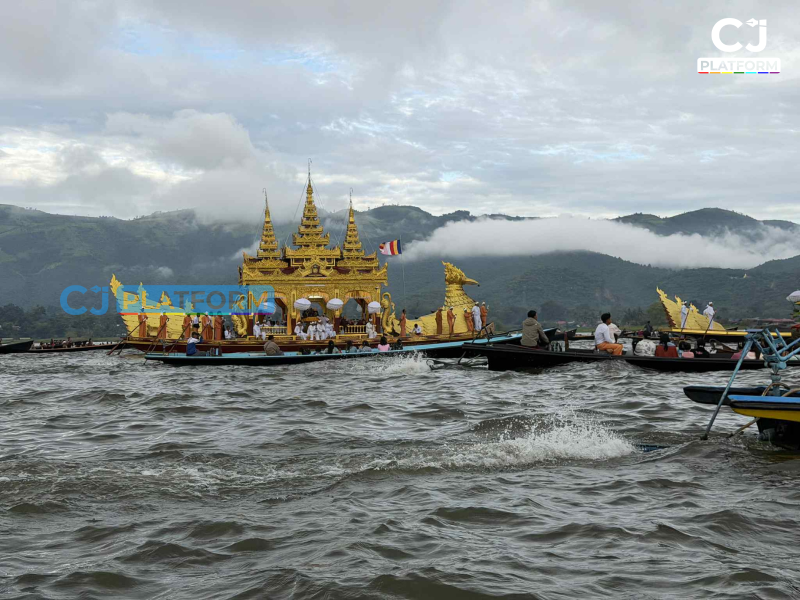
Inle Lake, the second-largest lake in Myanmar, is situated in the heart of the Nyaungshwe Valley in southern Shan State. The world-famous Phaung Daw Oo Pagoda stands as a defining symbol of the Inle area.
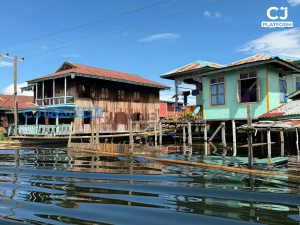
The Bilu Creek, the main water resource for the Lawpita Hydropower Plant—a critical power source for Myanmar—originates from Inle Lake. From its source at the lake, the Bilu Creek flows through Karenni State to run the Lawpita turbines.
Dr. Saw Yu May, a professor from the Department of Water and Environmental Studies who joined the Civil Disobedience Movement (CDM), noted that while the beauty of Inle Lake is defined by its surrounding mountains, this very geography makes its ecosystem naturally vulnerable to severe degradation.
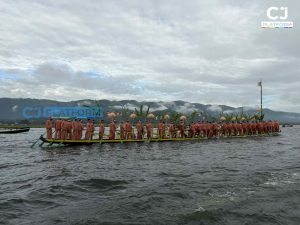
She also remarked that the primary cause of the lake’s decline is sedimentation. This is driven by several factors: the expansion of agricultural land and poppy cultivation through deforestation, charcoal production, lime extraction, and the clearing of forests to accommodate displaced persons fleeing conflict.
“I once trekked from Kalaw to Inle Lake over three days, sleeping along the way because I wanted to study the lake’s inlets and water flow. The situation in that area is dire due to agricultural expansion. There is massive soil erosion. It was then I realized that all that displaced soil eventually ends up at the bottom of Inle Lake,” Dr. Saw Yu May said.
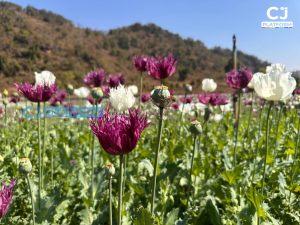
Natural phenomena, such as mountain runoff flowing into Inle Lake, are deeply interconnected with human factors like poppy cultivation. This complex web of causality has created an environmental crisis that is increasingly difficult to control.
Professor Dr. Saw Yu May warns that preserving this ecosystem is an urgent matter, not only for the local Intha people but for everyone who values the country’s natural heritage.
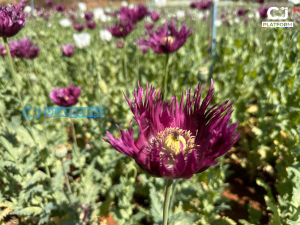
“Land use patterns around Inle Lake have shifted, causing silt and sediment to clog vital creeks like Tantaung and Indein,” Dr. Saw Yu May explained. “The local people feel powerless to stop it. My research across the watershed revealed that many don’t realize how their daily actions impact the lake. For instance, someone as far away as Pindaya isn’t acting out of malice; they simply don’t see the connection.”
The significant surge in poppy cultivation and the expansion of deforestation for shifting cultivation in Karenni and Southern Shan States are direct consequences of the post-coup conflict.
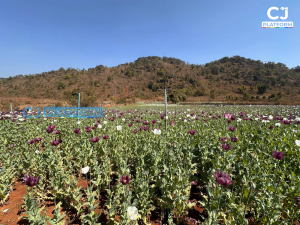
Displaced persons are clearing forests for upland farming just to survive. However, traditional crops often suffer from broken supply chains, a lack of buyers, and heavy financial losses. As a result, many are turning to poppy cultivation as a more reliable and marketable alternative.
“Poppies can be sold at home. Buyers come right to the firm. Some even make deals before the seeds are planted,” said Ko Oo, a resident of a village on the Southern Shan-Karenni border. “Still, the yield is unpredictable. It depends entirely on the season’s weather and water supply.”
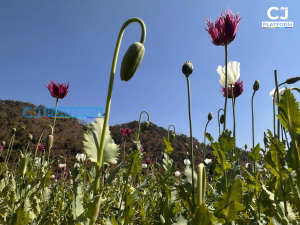
In southern Shan State, poppy farmers incur capital costs ranging from 4.5 to 7 million Kyats per acre. However, in western Demoso—which borders southern Shan—water scarcity drives the investment for a single acre up to approximately 20 million Kyats. According to a local plantation worker, this figure does not even factor in labor and general overhead costs.
“We are hired to guard the fields and earn one viss of dried raw opium per season,” the worker explained. “Water consumption is about one gallon every two days. Each water refill costs around 60,000 Kyats, and that excludes the expenses for weeding or scoring the poppy bulbs.”
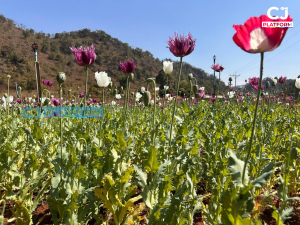
Currently, there is a lack of systematic measurement or protection regarding the deterioration of Inle Lake’s watershed systems.
A visitor from Yangon’s Hlaing Township, who recently reached Inle area, remarked that the lake has changed significantly over the last eight years, though the exact timeline of this decline is difficult to pinpoint.
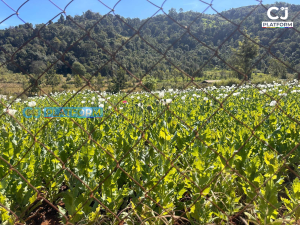
“During the visit, it was clear that daytime temperatures at Inle Lake have risen,” the visitor noted. “Additionally, the water level has dropped. In certain areas, boat paddles now strike the lake bed. While the outward appearance remains somewhat similar, the transformation is noticeable enough that everyone comments on it.”
A woman living on the upper embankment of the lake observed that the most extensive poppy cultivation occurs toward Pekon Lake. She added that in the post-coup period, natural disasters—including mountain collapses, landslides, and flooding—have resulted in fatalities. Despite these tragedies, restoration efforts have yet to yield effective results.
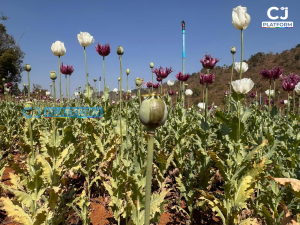
“In September 2024, the area suffered from mountain collapses and landslides. Silt flooded the lake, floating islands vanished, and water hyacinths congested the Moebye Bridge,” a local stated. “This leads to extreme flooding during the rainy season, while in the summer, the lake becomes dangerously shallow due to sediment buildup. An earthquake during that same period also caused water levels to drop significantly for a time.”
A representative from an Inle Lake conservation movement noted that poppy plantations are expanding rapidly from Nyaunglebin village toward the lakeshore at Nantoke village. In Hsihseng and Pinlaung townships, cultivation areas have grown by nearly 20 acres. Both locals and displaced persons are now growing poppies on a small scale—a trend the official describes as “inviting a natural disaster.”
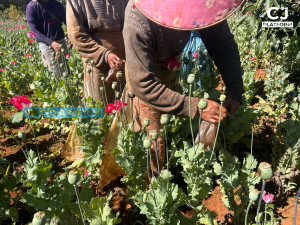
“Poppy fields are increasing in Pinlaung and Hsihseng. Because these areas are distant from the lake, locals are not yet concerned. However, the stretch along Pekon Lake is now dominated by poppy fields,” the official explained.
“Consequently, the climate is changing noticeably and becoming hotter. In 2024, heavy rains throughout the year caused some farmers to lose their summer paddy, while others saw their monsoon seedlings submerged. By 2025, flooding worsened because the silt could not be cleared. Furthermore, field surveys are currently impossible to conduct due to the risks posed by both the junta regime and revolutionary forces.”
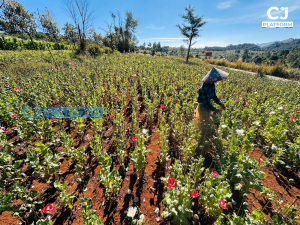
A local water resource expert pointed out that water scarcity in Inle Lake is directly linked to poppy cultivation. He warned that without proper management, Pekon Lake could disappear entirely, and Inle Lake will continue to silt up. He added that across Southern Shan State and the Karenni-Shan border, water is being diverted for poppy irrigation, and fertilizers are leaching into the groundwater. This creates a dire risk of extinction for many aquatic species, yet no effective restoration plans have been implemented.
Rather than halting cultivation, the junta and local armed groups have supported its long-term entrenchment since long before the coup. An administrative official from the Shan-Karenni border stated that junta forces maintain “showcase” poppy fields to destroy for the media to project authority. In reality, a collaborative business interest has existed for over 50 years and remains unchallenged.
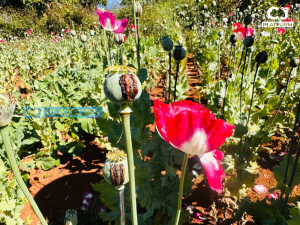
According to the UNODC “Myanmar Opium Survey,” poppy cultivation in Myanmar surged from a 2% increase in 2021 to 33% in 2022. By 2023, production reached 1,080 metric tons across 47,100 hectares, maintaining Myanmar’s position as the world’s leading opium producer.
The border official added that this increase is a long-term project for the junta and its armed business partners. Since farmers cannot even sell substitute crops, such as avocados, no clear solution currently exists to halt the trade.
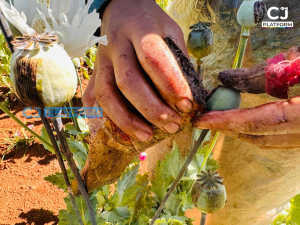
“If the relevant officials truly desired to eradicate poppy cultivation, it would have happened long ago. Instead, the police, the army, and local ethnic armed organizations all collect taxes and protection fees,” the official said. “Farmers even plant communal ‘sacrifice’ plots specifically for authorities to destroy for show. Poppy farming isn’t a recent development; it has become a traditional livelihood.”
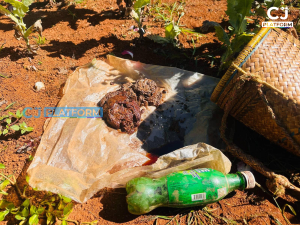
With nearly 500 displaced persons and locals expanding small-scale cultivation in Southern Shan and Western Demoso, opium production is trending higher than last year. Driven by post-coup conflict, ordinary citizens have been displaced and forced to clear forests for shifting cultivation to survive. When these crops fail due to ongoing instability, they turn to poppies. In their struggle for survival, they are inadvertently contributing to the destruction of Inle Lake and Bilu Creek.
“This story was supported by Internews’ Earth Journalism Network”