

Chindwin: A river on the Verge of Extinction
The Chindwin River is a major waterway flowing from north to south through Myanmar, originating in the Patkai Range and the Kumon Mountains. Stretching approximately 750 miles, Chindwin is the largest tributary of the Ayeyarwady River. Near the town of Myingyan, it converges with and helps sustain the great Ayeyarwady.
“We now have to pay extremely high prices even for vegetables that used to be very cheap. Throughout the monsoon season, tomatoes have cost 7,000 kyats per Viss, a gourd 4,000 kyats, and pork 25,000 kyats per Viss. These are things we have never experienced before. Everything is ruined, and we are suffering. It would be better if this [current situation] had never happened or could now disappear,” said a local elderly man Ba Gyi Aung, gazing at the spot where his old plantation once stood on a silt-land island (alluvial island) along the Chindwin River.
Ba Gyi Aung in his 70s is a native of Myauk Chun Village in Minkin Township, Sagaing Region. Since his youth, agriculture has been his only livelihood. The fertile silt-land islands along the Chindwin, naturally enriched by sediment, have been his lifelong companion. And he no longer has any land to cultivate.
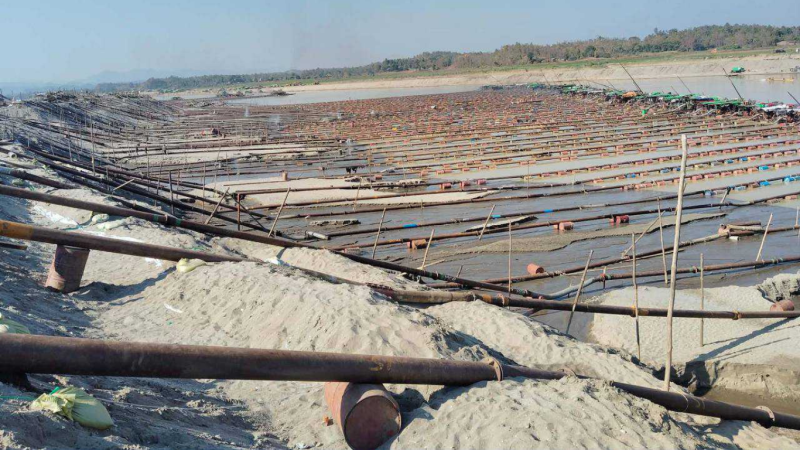
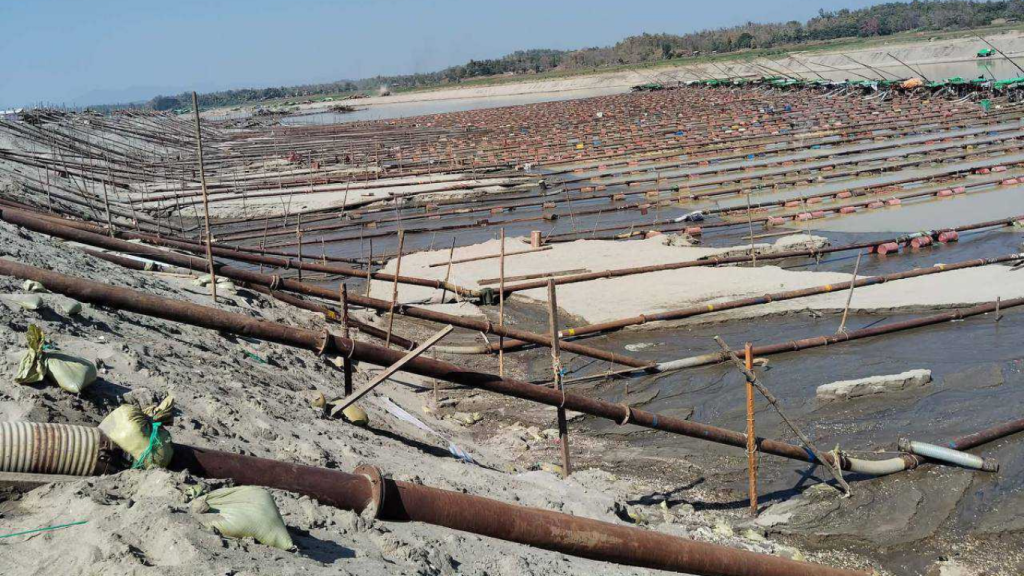
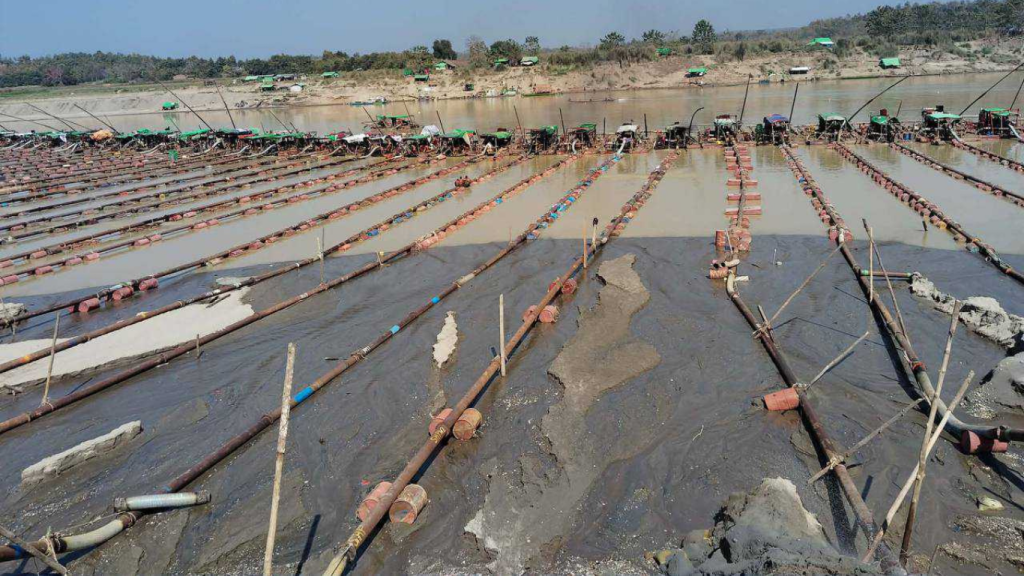
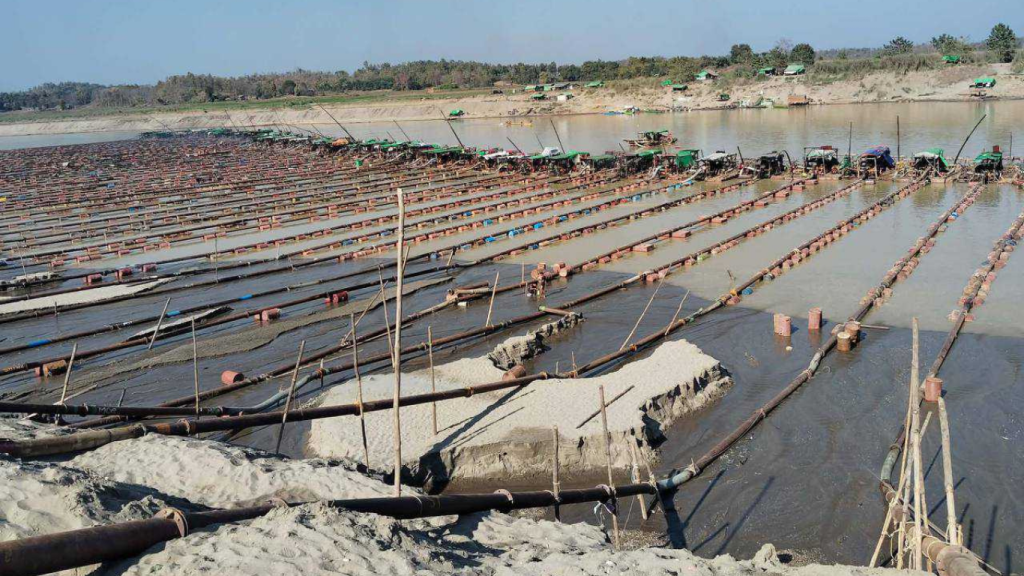
Where his plantation once stood, rafts and pipes are now lined up in rows. Floating mining rafts are scattered across the Chindwin River, filled with the deafening, rhythmic clatter of heavy machinery.
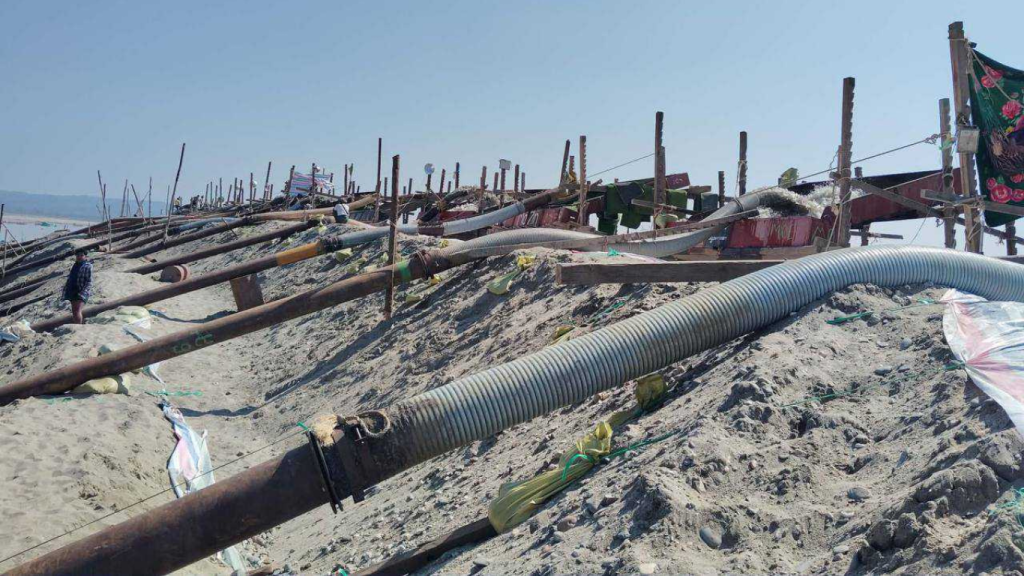
Ba Gyi Aung’s silt-land island has been transformed into an alluvial gold mining site by gold diggers driven by greed.
Since ancient times, communities upstream of the Chindwin River have traditionally sifted for gold on a small, manageable scale. Originating in vast mountain ranges, the Chindwin carries abundant water resources and has long provided precious gold dust to local people.
On February 1, 2021, Myanmar’s military seized power from the civilian government led by Daw Aung San Suu Kyi. During the period of military rule, the rule of law has collapsed entirely.
Pro-democracy supporters opposing the coup formed revolutionary forces and took up arms against the junta.
Ba Gyi Aung’s native village, Myauk Chun, and most villages along the Chindwin River were among the earliest areas liberated from junta rule, beginning in late 2021.
To fund the operation of local administrative bodies, the Chindwin River itself was eventually put to use.
From mid-2022, resistance forces invited business entrepreneurs to carry out gold mining operations in the Chindwin River through a bidding process worth ten of billions of kyats. However, residents objected to the plan.
By early 2024, alluvial gold mining sites had reached the vicinity of Ba Gyi Aung’s village, Myauk Chun.
“They have designated it as an alluvial gold mining site; they have taken about half of the silt-land island as if they had seized it,” Ba Gyi Aung said.
The silt-land island that Ba Gyi Aung and others had cleared and cultivated from the beginning was once a peaceful area covering more than 250 acres and providing livelihoods for many local families. Now, less than one-third of the original cultivable land remains.
In addition to the degradation of fertile silt-land islands used for cultivation and livelihoods, Ba Gyi Aung and his fellow villagers are suffering from the impacts of informal alluvial gold mining operations.
Alluvial gold mining in the river involves attaching pipes as long as six feet or more to rafts and lowering them about ten feet below the riverbed. Large machines then suck up riverbed material and pour it over filters or sieves (locally known as “velvet cloths”). Mercury is used to bind and extract gold from the sediment. The riverbed is suctioned until the underlying bedrock is exposed, and mercury-contaminated runoff is discharged back into the river. The great Chindwin River is now on the verge of extinction.
“When they use those pipes to suction up all the sediment, it creates deep holes. It is like a paved road in a city; the rough bedrock appears because everything else has been stripped away. Our villagers and the local community suffer losses. The mining owners and [the authorities] lose nothing; they only make a profit. The loss belongs to the entire village, the entire tract,” Ba Gyi Aung said.
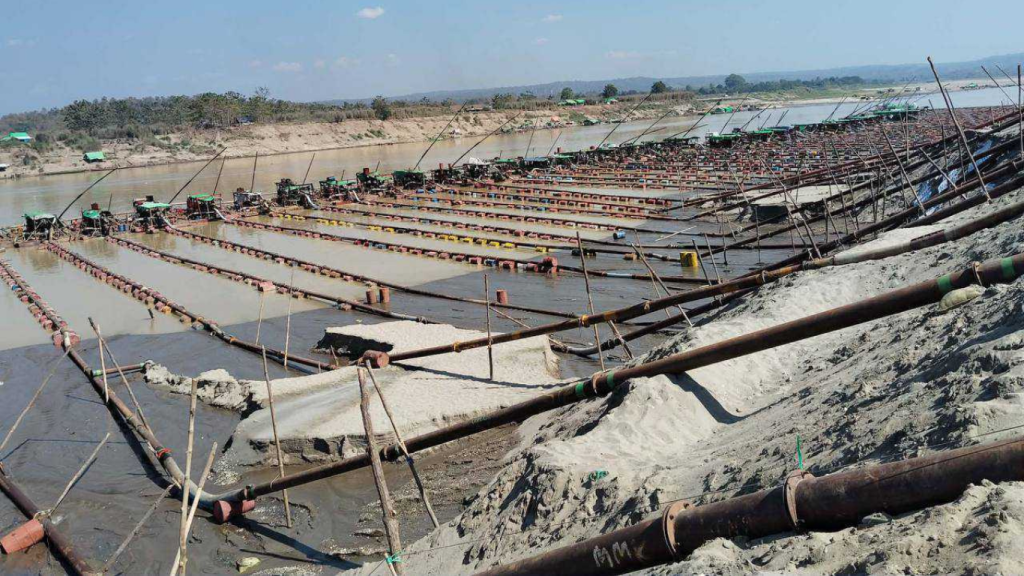
Waste soil discarded by gold mining operations has destroyed local agricultural land. The Chindwin River water, which Ba Gyi Aung and his community have relied on for drinking their entire lives, is no longer usable.
“In the past, the water was crystal clear during this season. Now, we have to collect water and store it until the sediment settles before we can use it. If we want to use it in the morning, we must collect it the evening before. There is so much sediment, and sometimes oil slicks caused by gold mining activities can be seen floating on the water,” said a local woman from Myauk Chun Village.
Furthermore, no one monitors or inspects the toxic, mercury-contaminated liquids discharged from the gold mining sites.
It remains unclear how these gold mining operations are meant to benefit local communities. At present, the Chindwin River water is undrinkable, and those who use it for bathing have begun developing skin diseases.
“The people working at the alluvial gold mines discharge everything into the river, even human waste. All the waste from the gold extraction process goes into the river as well. Many people—both children and adults—who have to bathe in the river are covered in itchy sores and rashes,” said a local man in his 40s.
There are no doctors to treat these diseases, and no one to protect the Chindwin River. For Ba Gyi Aung and other local residents, there is no one to rely on.
“The locals were threatened with arrest or death if they protested against these gold mining sites. Even before the operations began in Myauk Chun, they attempted to assassinate the leader of the local People’s Defence Organisation (PaKaFa) from In Kone Gyi village because he opposed the informal gold mining activities. He was eventually forced to flee,” said a resident of Myauk Chun in his 30s.
There are approximately 200 alluvial gold mining rafts operating near Ba Gyi Aung’s village. Those controlling the mining sites are officials from the Mingin Township resistance forces, who collect so-called “tax fees” ranging from 10 million to 30 million kyats per raft each month.
“Around mid-November last year, they granted permission to continue mining operations for an eight-month term, collecting between 10 million and 30 million kyats per raft,” said a man in his 40s from Myauk Chun, explaining the costs of an alluvial mining site he is familiar with.
One gold mine site owner confirmed: “It is collected for ‘funding.’ For the first payment, we had to pay a tax of 100 million kyats. In the following months, we pay taxes based on the amount of gold we extract.”
What Ba Gyi Aung and other locals understand is that the National Unity Government (NUG) is not selling the gold mining sites but granting production permits for a limited period. They were told the operations are supervised by environmental conservation committees from five local resistance forces. However, they do not know how this supervision is carried out or how the collected funds are ultimately used.
“Gambling dens such as animal dice games, KTVs and massage parlours—there are so many of them. They are operating right inside the designated gold mining areas. They were built next to local administration offices. All these activities are run together at the same time,” Ba Gyi Aung said, describing what he has witnessed.
The Mingin Township People’s Administration Team (PaAhPa) said that taxes and funds generated from the gold mining sites are distributed and used at different levels.
“We have to ensure that the river and its banks are not destroyed during inspections. We also have to collect taxes for the [NUG] government. Revolutionary funds are allocated to the resistance forces, local funds go to the villages, and commercial taxes are given to the ministry,” an official from the Mingin Township People’s Administration Team said.
While the junta is preparing to damage the Ayeyarwady River—the lifeblood of Myanmar—through the Myitsone project, the Chindwin River, the Ayeyarwady’s main tributary, is already beginning to die due to gold mining operations.
No one is protecting the river from mercury contamination, riverbank destruction, or the loss of aquatic resources. If the 750-mile-long Chindwin River is not preserved in time, future generations may learn only from school textbooks that a great river called the Chindwin once existed in Myanmar, that people like Ba Gyi Aung once lived peacefully along its banks, and about those who ultimately destroyed it.
(Note: Names of residents have been withheld for their security.)
“This story was supported by Internews’ Earth Journalism Network”